


Guest Column: Pasture Mealybug on Turfgrass: What You Need to Know
A new pest has been detected in Florida that is a legitimate threat to property owners and the green industry. Pasture mealybugs, Heliococcus novovillei and Heliococcus summervillei, are sap-feeding insects that are proven to be pests of grasses, including pasture grasses, sugarcane, and turfgrasses.
The first confirmed case of pasture mealybug in Florida was reported in May 2026. It has rapidly spread across the state, and is now confirmed in 28 counties.
Pasture mealybugs cause grasses to yellow, turn reddish/purple, and die back. These symptoms can resemble drought, but the grass will not recover from irrigation/precipitation. This insect tends to reach high densities and cause widespread grass dieback.
Pasture mealybug has been found in bahiagrass, bermudagrass, and several other grasses in pastures, sugarcane, roadsides, rights-of-way, and low-input utility infrastructure settings. We do not yet have any confirmed cases in managed turfgrass in Florida. However, in Texas over the past year, it has become a pest of turfgrasses, including St. Augustinegrass and centipedegrass. In Florida thus far, the insect tends to show up and become damaging in low-input, infrequently mown grass stands like bahiagrass.
So what should you do about pasture mealybugs? “Scout. Scout. Scout!” is what Adam Dale, PhD, recommends. Dale is an associate professor in UF/IFAS’ Entomology and Nematology Department and the lead turfgrass expert on the Pasture Mealybug Taskforce, which was formed this summer to coordinate research and provide education for Florida stakeholders.
You should be on the lookout for yellowing and reddening grass leaves, he recommends. Mealybugs are white, waxy insects on the undersides and bases of grass. However, other common creatures can cause the same symptoms, and there are multiple mealybug species and other insects in grasses.
UF/IFAS Extension has a number of resources to help you confirm mealybug identification. If you suspect pasture mealybugs on your turfgrasses, contact your county UF/IFAS Extension office immediately.
It’s important to confirm ID before taking next steps, Dale warns. “I caution turfgrass managers against applying anything to prevent mealybug infestations because it can cause additional trouble. Insecticide applications should really be based on detection of the mealybug, and ideally before it reaches damaging densities,” he adds. In turfgrass, there are systemic insecticide options that should provide control, although we do not yet have data from Florida controlling pasture mealybug in turfgrass.
In the meantime, turfgrass workers should be diligent about where they are working and avoid transporting mealybugs on clothes and/or equipment. Cleaning equipment is an important best practice.
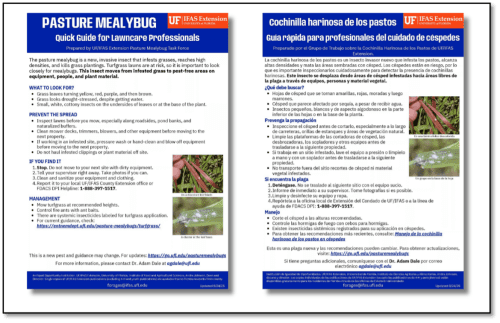
for lawncare professionals, parks, athletic fields
and public land crews, and residents. | Image Courtesy UF/IFAS
As for what to tell your clients, Dale recommends informing them there is a new invasive pest attacking grasses across the state, that turfgrasses are at risk, and that we all need to be on the lookout. Describe the symptoms, identifying features, and provide them with UF/IFAS resources.
FDACS is very actively conducting surveys for this pest throughout the state and working with local, state, and federal agencies to understand its movement, distribution, and management. UF/IFAS Extension and FDACS are working closely to conduct research to identify effective management strategies and support our affected stakeholder groups across Florida.
The UF/IFAS Entomology & Nematology Department has a one-stop-shop webpage dedicated to this insect pest where you can find the latest management recommendations, known Florida distribution, and UF/IFAS resources. You’ll find handy information in English and Spanish for green-industry professionals and Florida residents. Visit and bookmark: https://entnemdept.ufl.edu/pasture-mealybugs/.
It’s not a cause for panic, but it is vital that we take this threat seriously to prevent pasture mealybugs from gaining a foothold on Florida turfgrasses.
Andra Johnson, PhD, is the Dean and Director of UF/IFAS Extension and a champion for science-based solutions that serve Florida's agriculture and natural resources.
