Shipping Plant Materials
FNGLA offers this resource to assist those looking to have Florida plant materials shipped throughout the United States and Canada's provinces.


Shipping Plant Materials
FNGLA offers this resource to assist those looking to have Florida plant materials shipped throughout the United States and Canada's provinces.
Be prepared to plan ahead for the spring months! In the world of shipping plants, 'spring' generally is considered March, April and May. Begin contacting truck lines no later than January or February to get trucking lined up. Tropical Plant Int'l Expo (TPIE) is a great time to discuss spring shipping options with different service providers. Shipping during spring is very different compared to other times of the year due to increased demand. 'Spring' is considered peak shipping season. The start of the spring season is subject to influence by different factors. Shifts in weather and other factors can create a rush or a lull during the beginning or end of the spring shipping season.
During the colder months, have the nursery double sleeve and staple the tops of loose plants. Dish gardens should have bubble wrap on sides and bottom. Liners may be double-boxed and may potentially include a heat pack. Winter packaging is typically more expensive due to the extra precautions taken.
Shipping times vary depending on location and the method of shipment. The wait time is usually 2-7 days.
Check when driver opens the doors. Make sure everything is neat and orderly. Check your labels. If your box/loose count does not match your invoice, you should note the shortages immediately. Any discrepancies should be verified by driver. Note any discrepancies on bill of lading. Take note: loose plants are transported at the customer’s risk. Any damaged product should be documented and photographed and sent to the supplier right away.
To get an accurate quote, you will need to know what you are shipping. You'll also need to know how many boxes you are looking to ship, and what their sizes are. You'll also need to know how many loose plants, and what pot sizes they are in. Are they under or over 50 inches? As for large trees, are the pots greater than 17 inches in height? Are the trees greater than and have a spread inches? Is the spread greater than 24 inches? You will need to know pot size, and height when wrapped and spread. Be sure to clarify who is paying for the shipment prior to shipping (i.e. - broker, shipper, cosignee, etc.)
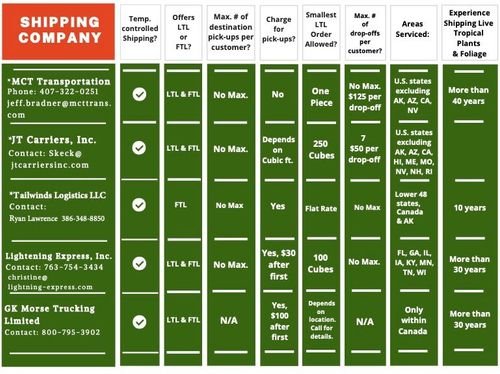
Find a Shipping Company
Here's a few shipping companies to help guide your search. FNGLA members are denoted below with an * next to their company's name.
Note: All information provided is strictly for guidance. Accuracy is intended, however not promised. Please contact providers to confirm.
Glossary of Shipping Terms
A minimum is a cubic foot or dollar amount, imposed by the carrier, to provide service to an area. If your total charges are less than the minimum you would be charged the minimum. Plant suppliers may also have minimum order amounts.
Plants can be shipped boxed. Box sizes are different for different plant material. The plant supplier can tell you the size boxes that will be used for your order. Plants can also be shipped in trays, on carts or loose in a protective sleeve. Sleeved plants may be single sleeved or double sleeved and the sleeve material may be paper, plastic or mesh. Plants do not ship without some type of protective packaging. Packaging for plants is decided on by the plant supplier and their customers.
Yes, foliage LTL trucks (such as MCT, Peninsula, C&S, JT Carriers) are climate controlled. Other carriers may NOT be climate controlled. Some other natural LTL carriers will NOT have climate controlled trucks. Always be sure to ask if trucks are climate controlled when considering a trucking company.
A cube is a cubic foot. Cube is the basis for determining the cost of shipping.
To determine cubes of boxes, multiply the width times the length times the height and divide by 1728. Width, length and height dimensions should be in inches. FNGLA offers a cube calculator on this landing page sidebar.
Send your delivery and contact information so the trucking co. can determine if your receiving address is capable of handling a tractor trailer with a 53’ trailer.
Please contact the carrier for information.
Shipping cost is highly variable and changes from carrier to carrier. These rates are usually priced based on the number of cubes you will be shipping. The cost to ship also depends highly on the delivery location with lead times highly structured. The range to ship (minimums notwithstanding) can range depending on location.
UPS/FedEx will likely be the least expensive when looking at the total freight cost, but comes with the highest risk of damage/death. LTL will be the next most cost efficient assuming you hit the minimums required by the carriers. FTL is reserved when, generally, 60%+ of a truck’s total available capacity. Cost, in terms of price per plant or price per cube, will be the lowest for FTL and usually most expensive for UPS/FedEx.
The differences are many. Chiefly, the difference would be that typical LTL freight is not temperature controlled where shipping foliage is shipped between 55-65 degrees which is the optimal temperature for foliage. Because shipping foliage entails shipping a lot of “air” the pricing structure for shipping is often different as well. Shipping standard items LTL is based, primarily, on weight because the trucks hauling more typical commodities will hit their DOT weight limit before they will fill the capacity. With foliage shipping we are more likely to fill a truck and never reach the maximum weight a truck can haul.
Shipping foliage through foliage LTL carriers can take anywhere between 2-7 days depending on the route and final destination.
See website for list of carriers
Communicate with supplier right away, document w/ photos. Claims are made based on the agreement made with the shipper. If you purchase plants from a supplier and the supplier arranges and pays for the freight then a claim should be filed with the supplier. If you have purchased plants from a supplier with an “FOB” agreement you should be filing claims directly with the carrier.
Document the damage and seek proof of quality from the shipper at the time it was picked up from their location. From there provide as much details as possible regarding the item, quantity, and the value of the items damaged. Any damaged product should be documented and photographed and sent to the supplier right away.
Corrugated boxes, wood pallet racks, carts. This is covered in the “How are the plants shipped?” section.
Open shipment promptly upon arrival, note/photograph & communicate any issues with supplier right away (based on FOB terms). Place plants in appropriate environment. (this depends on time of year and location). Ideally the plants stay in a slightly humid environment with sunlight and the temperature range between 55-80 degrees F. Be sure to count the items as they come off the truck and note any shortages on the driver's paperwork.