


Guest Column: New Extension Program Focuses on Sun Safe Workspaces
Everything may look clearer in daylight, but when it comes to sun exposure, some common myths and misconceptions can leave us in the dark.
For example, it is often thought that a suntan or sunburn is a sign of a “healthy glow”, that sunlight is the best natural source of Vitamin D, that only fair-skinned people are susceptible to skin cancer, or that you can’t get sunburned on a cloudy day.
But decades of research have dispelled these myths, and a new UF/IFAS Extension program is shedding light on how we can protect ourselves from the sun outdoors and on the job.
Outdoor professionals, including many working in the green industry, are at increased risk for skin cancer because they are exposed to high levels of ultraviolet (UV) radiation from the sun. Prolonged UV radiation can cause damage to skin cells, resulting in cancer. The most serious form of skin cancer is melanoma. This year, Floridians will experience 10,280 new melanoma cases; 780 will lead to death.
How much sun is too much?
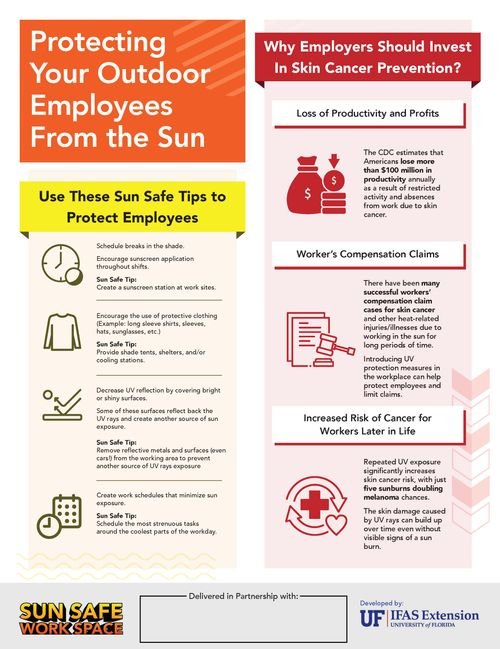
Just 15 minutes of UV exposure can lead to skin damage. If you’ve had more than five sunburns in your lifetime, you are at double the risk of developing a melanoma.
Fortunately, skin cancer is easily preventable and if detected early has a 99 percent chance of survival.
Sun Safe Workspace is a new education program developed by Melissa Vilaro, Ph.D., an assistant professor with the UF/IFAS Department of Family, Youth and Community Sciences and state specialized Extension agent for health and wellness. The program provides information and answers your questions about the causes of skin cancer, how workers and employers can protect themselves from UV overexposure, how to do a skin self-exam, warning signs to look for and when to seek health care professionals. Extension agents also use a special UV lamp to show participants how skin damage develops, and demonstrate what to look for in sunscreens and UV-protective clothing.
This information is especially important for landscapers, farms and nurseries, pesticide applicators and other businesses that work outdoors. Nearly $9 billion is spent annually on skin cancer treatment in the U.S., and skin cancer can also contribute to loss of productivity, higher insurance costs and workers’ compensation claims.
To keep your workspace sun safe, Vilaro recommends creating a station with broad-spectrum sunscreen (at least 30 SPF), encouraging workers to wear long sleeve shirts, hats and sunglasses, providing shade on the worksite, covering reflective surfaces and scheduling work to minimize sun exposure. Small investments in sun safety can yield long-term benefits in a healthier workspace.
The Sun Safe Workspace program was piloted in Brevard and Seminole counties, and Vilaro has started up an in-service program to get more Extension agents trained in offering sun safety education.
If you’re interested in having Sun Safe Workspace training at your business, contact your local UF/IFAS Extension office.
Andra D. Johnson, Ph.D., is the Dean for UF/IFAS Extension and the Director of the Florida Cooperative Extension Service
